From WiTE to an ICML poster
How Gloria went from a curiosity visit to presenting her own research on uncertainty at one of machine learning’s largest conferences.
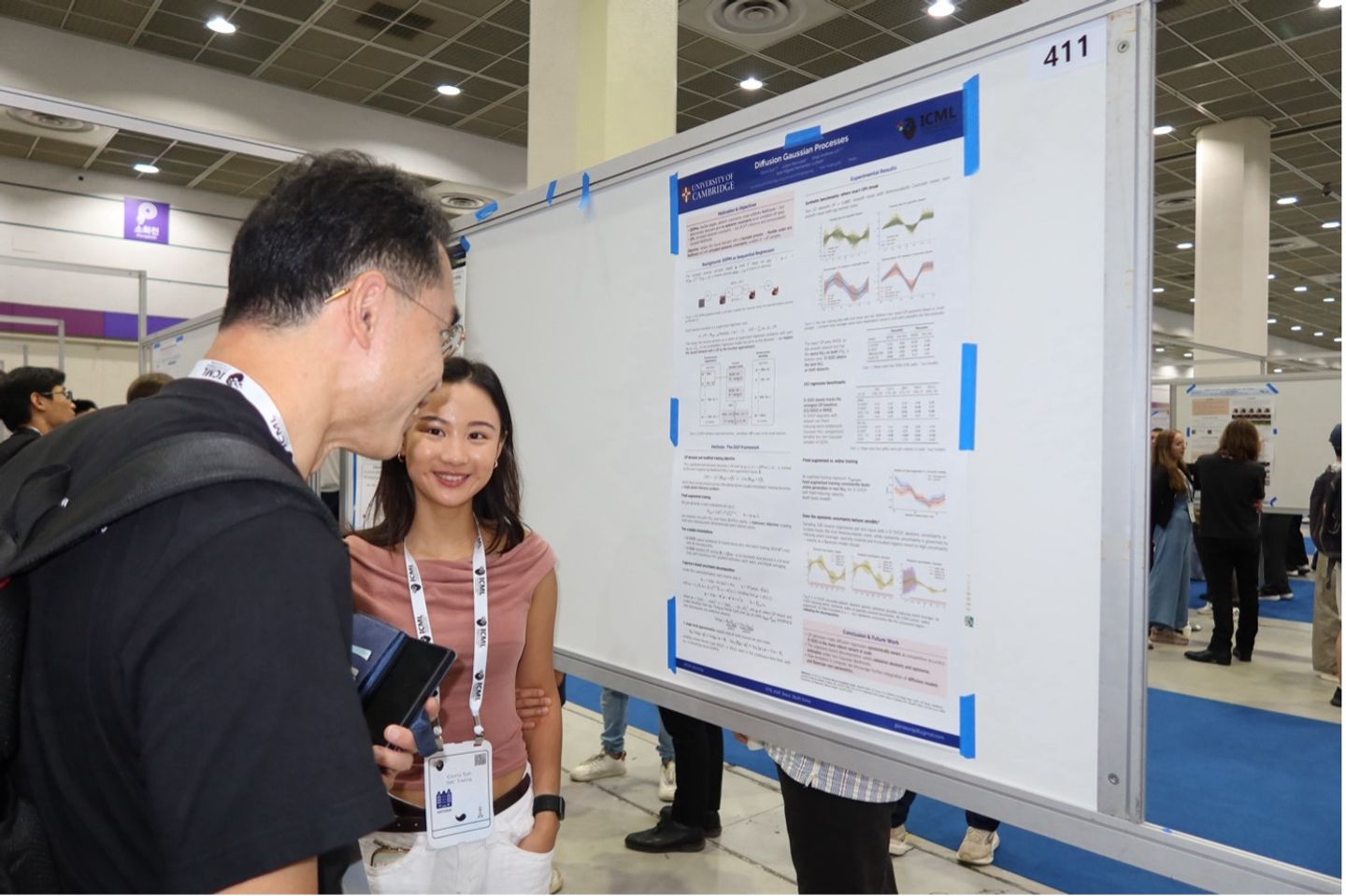
Every model that informs a trading decision carries two questions. What does it predict, and how much should we trust the prediction? The second question is easy to skip, and expensive to skip in a market where the data runs thin. Gloria’s research is an attempt to answer both at once.
She presented it at ICML in Seoul this year, eighteen months after walking into an IMC program out of curiosity, and a year into trading US index options.
From University, to Options Trader, to presenting a poster on Diffusion Gaussian Processes
Gloria’s route to IMC started with a Women in Trading and Engineering program in 2025. She went out of curiosity, to see what a career in trading could look like.
"I attended the WiTE event out of interest to learn more about the firm, and had a great experience there and learning about what trading is like at IMC specifically."
The program fast tracked her into the final round for our graduate trading role. Four months later she had an offer. Twelve months after that she was on a desk trading US index options, with a focus on externalisation and monetisation. Six months after that she was presenting at ICML.
"Everything moved extremely fast. Thinking back, I still feel very grateful for attending the program and exposing myself to opportunities like this. I would encourage anyone still at uni to do the same."
Gloria studied Engineering as an undergraduate, followed by a Master’s in Machine Learning. The dissertation she wrote during that Master’s didn’t stay on a university server. It became the paper she presented in Seoul.
What are Diffusion Gaussian Processes?
Gloria’s research combines diffusion models with Gaussian Processes to improve variance quantification. The diffusion mechanism handles complex, arbitrary distributions. The Gaussian Process quantifies model uncertainty. Each side covers the other’s weakness.
"The paper combines Bayesian learning, a more classical topic in the field of ML, with trendier modern models like generative modelling to try to improve estimates of both epistemic and aleatoric uncertainties."
That distinction is where the work does its job. Epistemic uncertainty is the model admitting it hasn’t seen enough data. Aleatoric uncertainty is noise that more data will never remove. Telling them apart is the difference between a forecast that says “rain tomorrow” and one that says “30 percent chance of rain, and here’s why we’re unsure.”
She chose the topic because the problem doesn’t go out of date.
"Uncertainty quantification will always stay relevant for many applications, especially those with high-stake impact like healthcare and finance. So it’s exciting to work on a general framework that’s new and could potentially be applied to many different things."
How certain is your model, really?
Gloria wrote the paper before she started trading. Its relevance to the job became clear afterwards.
"In trading, on one hand it’s important to model the actual distributions of the quantities we’re interested in, for example PnL. But it’s also important to know how certain we are in our predictions. It’s easy to overlook the latter and become over-confident in making our trading decisions based on the models, especially in data-sparse regimes."
Her framework optimises for both at once: better PnL predictions, with an uncertainty estimate attached to them.
"I first worked on this paper as my Master’s dissertation without specifically considering it for trading. After joining the industry I’ve realised how relevant it is to the job, and that it’s a problem people have consistently tackled."
“It’s easy to become over-confident in making our trading decisions based on the models, especially in data-sparse regimes.”
Two jobs, one poster
Having a paper accepted while working full time gave Gloria two roles for the week. She took questions at her poster, and she talked to other researchers about IMC.
"Getting it accepted while working at IMC offered me the opportunity to experience the conference from a recruiter’s point of view, which is a very different perspective that’s great to have."
She also used the conference as a great way to learn and connect with other industry leaders in the space.
"Attending large, international conferences like this really enriches my views on the latest progressions in topics of interest, for example improvements of techniques we apply at IMC, but also improvements of solutions to the problems we want to solve."
Another takeaway was how her colleagues currently use diffusion models.
"It’s extremely insightful to speak to people from other offices. I was really impressed by the sort of work they do in APAC."
Talking to a colleague in another office, Damien, who’d been part of the IMC delegation at ICLR in Rio a few months earlier, she learned that teams here already work with diffusion models and Gaussian Processes — the two halves of her paper.
“At many trading firms, departments and researchers operate in silos, with limited collaboration across teams. IMC’s culture is different. We believe good ideas often emerge when researchers bring different perspectives to a problem and learn from colleagues with complementary expertise. Researchers around the world are therefore strongly encouraged to collaborate and stay abreast of new ideas and findings—both within IMC and across academia.
After meeting Gloria at a major AI conference, we quickly recognised an overlap between her work and research themes we had explored in APAC. We shared insights into how we had applied related techniques to a range of real-world business problems and suggested several ideas for her to consider. She was pleased to discover that IMC had quantitative researchers with extensive experience in the field who could serve as sounding boards for future ideas.”
Damien, QR in Systematic Equities
For more reflections on ICML read here
Research, trading and engineering work here as one loop rather than three silos. A trader’s observation becomes a researcher’s experiment; an engineer turns the result into something that runs. Gloria arrived at ICML as a researcher presenting her own work, and left with a line into colleagues already approaching the same problem from a different angle.
Why should a trading firm back research?
We supported the trip, and Gloria is specific about what that looked like: colleagues were keen to get her there and our people showed up to support her for her presentation session.
Her case for the investment is a practical one.
"It matters for trading firms to invest in people continuing their research, because I do think it contributes a lot to the idea generation and exploration processes, which is of course where a lot of good applications in prod come from."
She also thinks we should be more visible at these conferences, publishing open-source general framework papers and giving talks. Her reason is direct.
"People in ML academia tend to associate industry with boring or constrained research work. They shouldn’t make that assumption."
That assumption is worth addressing, because it stops strong researchers from applying. Her answer to anyone who believes joining a trading firm means the end of publishing is straightforward.
"With IMC at least, this process is quite flexible as long as it’s not on proprietary information. My work is more like a general framework that can be applied to many industries, including finance, so they shouldn’t make that assumption."
What a year on the desk changed
A year of trading has shifted the kind of problem Gloria wants to work on.
"It’s made me much more application and production-driven rather than staying in the theoretical land. Some research is fun to do just because of the concepts themselves, but since joining the industry my focus has shifted to those that I think are more likely to create an impact."
The speed is part of the appeal.
"The problems are interesting and intellectually stimulate me. In this industry, you also get to see actual impact in production very quickly, and that in turn creates more motivation and excitement."
She’s also clear that industry research is not academic research with a different address.
"This fast feedback loop is what makes it different from academic research. Things are less analytical, and you often have to rely on trial and error to make things work numerically. This practicality, to me, is also a plus."
Her plan is to keep exploring problems in the field and keep her knowledge current as machine learning becomes more central to trading. Eighteen months in, the paper is presented, the desk is live, and the next question is already open.